In Person Event
REPLAY

Development Finance Forum

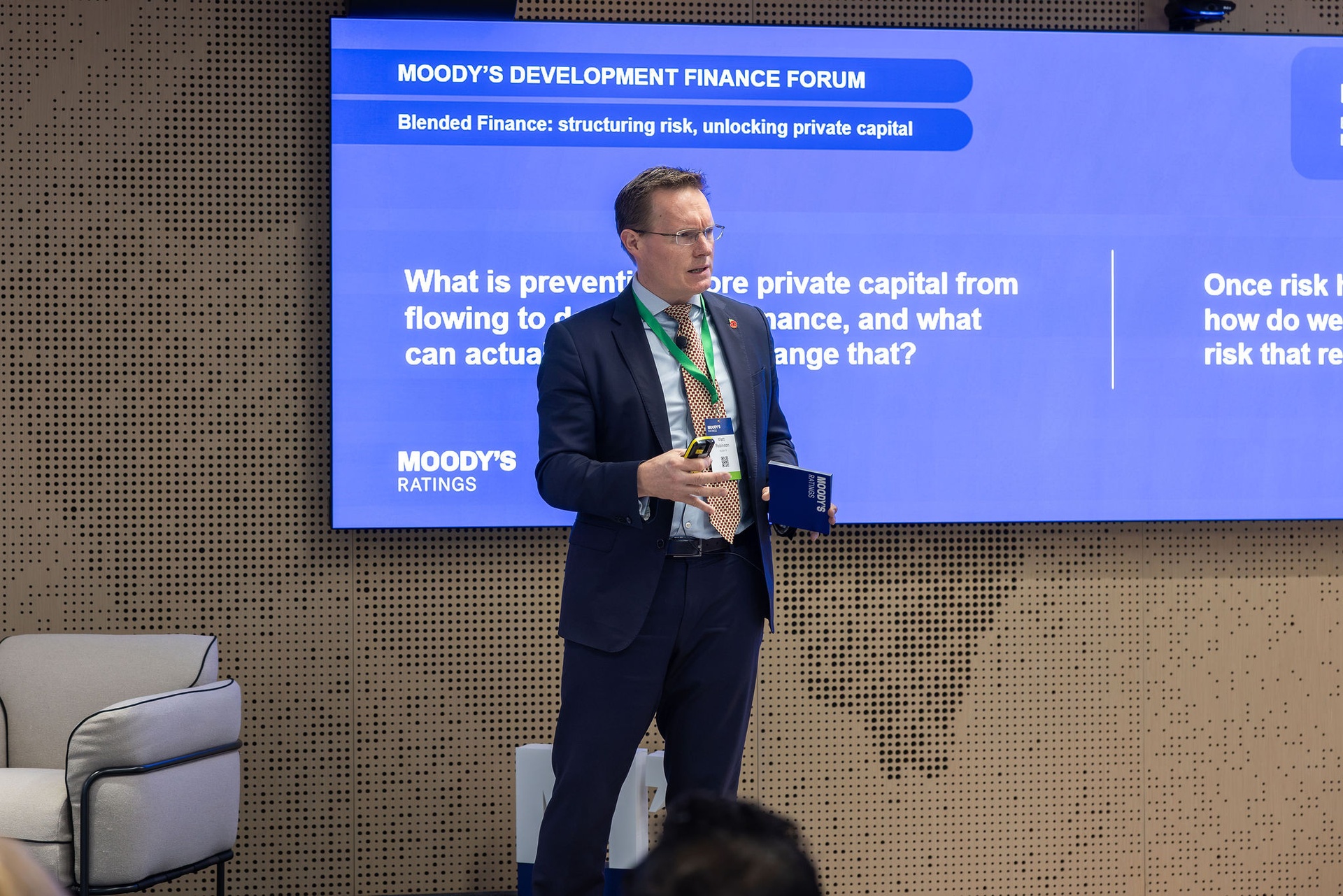
Blended finance: structuring risk, unlocking private capital

Registration is now closed.

location_on 10 Gresham Street Map
Replay · Listen on demand

Where risk sits in development finance

What is stopping private capital from reaching development finance at scale? Moody’s Ratings’ first Development Finance Forum examined where emerging market risk sits, how blended structures reallocate it and what remains with investors. Listen to highlights from four sessions spanning data, funds and individual transactions.

Thursday, 5 November 2026Moody’s London Headquarters, London6 clips · 5 min

Session 1 · Presentation

Blended finance in the context of global development finance needs

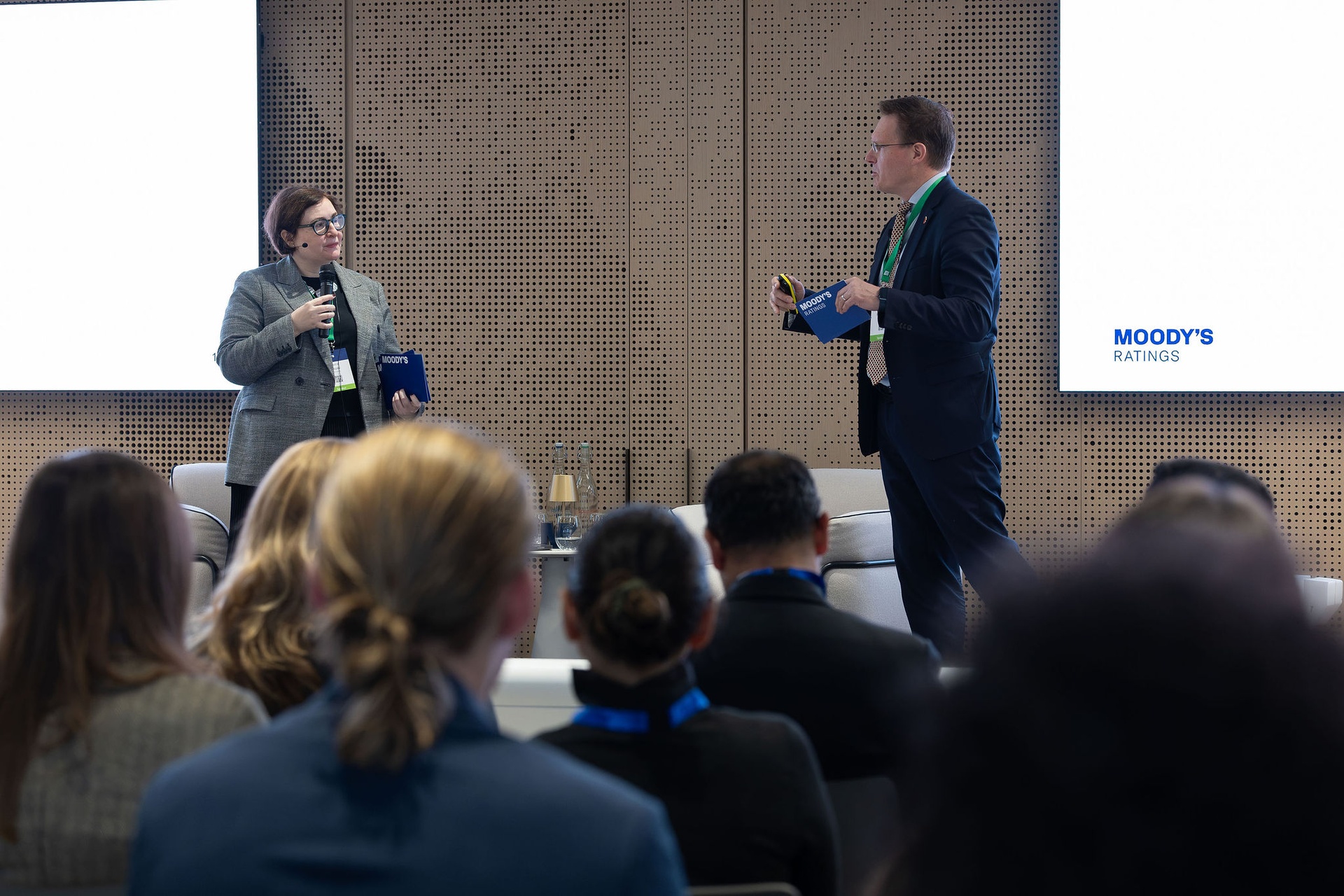
Is emerging market risk misperceived, or simply more nuanced than headline default rates suggest? Matt Robinson and Lucia Lopez of Moody’s Ratings set rising financing needs against default and recovery data.

Key takeaways

  1. Needs and aid are moving in opposite directions. Official aid grew in the early 2020s, has tapered over the last three to four years and is expected to fall further towards 2030. Public balance sheets cannot absorb the shortfall.

  2. Default risk is higher; loss risk is more nuanced. Emerging market project finance defaults are more than double those in advanced economies (8.1% vs 3.6%). Recovery rates average about 77%, slightly above advanced economies.

  3. Restructuring often ends without loss. More than half of restructured emerging market loans exit with full recovery, so loss given default matters as much as default frequency.

  4. Investability depends on cash flow, not need. Credit enhancement requirements rise across a spectrum, from desalination (low) and water efficiency (low to moderate) to asset protection (moderate to high) and marine conservation.

  5. Diversification has limits. Portfolios spread across assets, contracts and countries can still share physical climate, transition and water exposures, and these overlap significantly across emerging market sovereigns.

Listen

Matt Robinson
1:12

Risk is real, but nuanced

“Now, a lot is often said that risk is misperceived in emerging markets, and that’s not quite right. Risk is real, but it’s more nuanced than the headline would suggest. Our data, this is Moody’s analytics data, this is the project finance, unrated bank loans data submitted by the consortium of banks. It shows that defaults in emerging markets are more than double the defaults in advanced economies. The 8.1% in the 2026 study versus 3.6%, I think it is for advanced economies in the 2026 study. That doesn’t mean every emerging market investment is twice as risky as an advanced economy investment, but it does really underscore the point that jurisdiction matters and rather than telling an investor ignore the risk or you’re misperceiving the risk, you need to do something about that and change the risk profile. And that’s where blended finance comes in.”


Matt RobinsonExecutive Director, Sovereign Risk, Moody’s Ratings
Lucia Lopez
0:40

Why adaptation struggles to attract capital

“For adaptation, the benefits can be much harder to identify financially. They might be diffused, they might accrue over a much longer period of time, or there might be substantial social or countrywide benefits that benefit communities, but they’re not really monetizable for private investors. So the key distinction is not really whether what’s the underlying activity or what’s the importance of the development need, is whether those assets can generate an identifiable underlying cash flow that can actually be structured for the benefit of the private capital and in structures that investors can identify and understand.”

Lucia LopezExecutive Director, Global Head of Credit, Sustainable Finance, Moody’s Ratings
Lucia Lopez
0:33

Diversification does not remove climate risk

“So you can have, for instance, rivers that flow through different countries that of course will generate water or could generate water management issues for different countries at the same time or extreme weather events that affect different countries at the same time and with different characteristics. So I think the key message from us here is that geographical sectoral diversification doesn’t necessarily eliminate correlated environmental risks. So if risks cannot be diversified away, then I think the question remains who continues to bear the risk in the structures.”

Lucia LopezExecutive Director, Global Head of Credit, Sustainable Finance, Moody’s Ratings
Session 3 · Panel

How blended finance structures crowd in private capital

Is concessional capital a temporary first mover, or a lasting source of cheap leverage? Kathrin Muehlbronner of Moody’s Ratings explains how manager track record and junior capital shape the assessment, alongside panellists from Ashmore, responsAbility and KfW.

Key takeaways

  1. The 2019–20 peak in demand was driven by rates, not only impact. Near-zero rates in developed markets pushed capital into emerging markets. Higher rates, declining donor budgets and the shift towards defence spending have since reversed both private appetite and catalytic supply.

  2. Concessional capital does two different jobs. It can act as a time-limited first mover that builds a track record and then exits. Or it can provide permanent cheap leverage that turns single B assets into investment grade notes, which needs below-market returns at the base.

  3. Protection levels fall as track records build. Older funds had four layers with asymmetric terms; newer funds use two tranches with pari passu returns. Raising junior returns and adding adaptation sleeves helped attract junior capital.

  4. Moody’s weighs the size and permanence of junior capital. Undated junior capital counts as equity; shorter-dated, more senior tranches receive about 50% credit. Long redemption lead times mitigate exit options for public investors.

  5. Standardisation and local currency pull in opposite directions. Aligned documentation shortens 12–20 month due diligence cycles. FX-absorbing junior layers can add six or seven tranches, which works against scale.

Listen

Kathrin Muehlbronner
0:48

What Moody’s looks for in funds

“And track record of the fund manager, the governance and the risk management framework is one of the key factors that we look at. The funds all operate with very clear risk limits. So we look at those, how prudent are they? We look at stress testing, how prudent, how frequent is that, and the track record and credibility of the fund manager. So that’s certainly one key aspect for our rating assessment. The other one is, is the size of the junior capital. Very clearly everything else equal, a bigger size of junior capital provides more protection to the senior note holders. And that’s what the ratings ultimately speak to.”

Kathrin MuehlbronnerSenior Vice President, Global MDB Lead, Sovereign Risk, Moody’s Ratings
Session 4 · Panel

Risk transfer and credit enhancement in practice

When a guarantee or insurance policy is in place, what risk still sits with investors? Kevin Maddick of Moody’s Ratings examines the gaps political risk cover can leave, alongside panellists from MUFG and GuarantCo.

Key takeaways

  1. Credit support runs along a five-part spectrum: full guarantees, partial guarantees, PRI on sovereign payment obligations, PRI on commercial contracts, and contingent subordinated debt. Each step leaves more project risk with investors.

  2. For insurance-based cover, liquidity is critical. Claims determination and arbitration periods can delay payout, so liquidity facilities that keep coupons paid are central to the credit outcome.

  3. PRI can leave gaps against the risks that bite in practice: slow currency depreciation against dollar debt, grid curtailment, weak utility offtakers and operational risks such as access to spares. Ring-fenced hard-currency revenue accounts can address some of these.

  4. The investor base is narrow and structures adapt to it. One programme sounded 80 investors, eight reached credit committee and four closed. Twenty transactions later, it still works with about 15. Tranches are often tailored to investor constraints rather than to the underlying risk.

  5. Donor capital works best as proof of concept. In one series, a guarantee on the mezzanine tranche was needed for early issuances and dropped by the fifth. Donor guarantees carry a cost that some investors will not pay and origination of placeable deals remains a constraint.

Listen

Kevin Maddick
0:54

The gaps in political risk cover

On political risk insurance: “That is helpful to a transaction, but is not necessarily the silver bullet because we have looked at transactions, for example, renewables in Africa where there is political risk insurance available. So it will cover the risk of the government nationalizing the asset or sequestrating the asset. But there are sometimes gaps in PRI policies that there’s other risks around, well, what if it’s dollar denominated debt and you’ve got local revenues, you then have a slow currency depreciation problem. Or if you’ve got a renewable project that to enable it to generate revenues, you need to export your electricity to the system. But there’s a problem with the grid, which you don’t control.”

Kevin MaddickExecutive Director, Project Infrastructure Finance, Moody’s Ratings
Photography

From the day

About this event

Development Finance Forum 2026

On 5 November 2026 Moody’s Ratings held its first Development Finance Forum at its London headquarters, 10 Gresham Street. Analysts, development finance institutions and investors from British International Investment, Ashmore, responsAbility, KfW, MUFG and GuarantCo discussed where emerging market risk sits, how blended finance structures reallocate it, and what remains with investors.

Date
Thursday, 5 November 2026, 8:15 – 13:00 GMT
Venue
Moody’s London Headquarters, 10 Gresham Street, London EC2V 7AE, United Kingdom
Organiser
Moody’s Ratings
Theme
Blended finance: structuring risk, unlocking private capital
Speakers from
British International Investment plc, Ashmore Group, responsAbility, KfW Development Bank, GuarantCo, MUFG Bank and EBRD
On demand
Highlights of 4 sessions: key takeaways and 6 audio clips